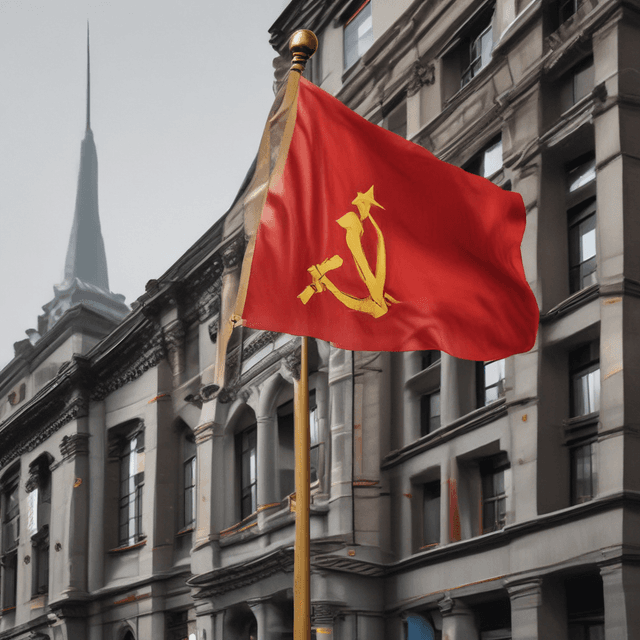
| Name | People's Republic of Serbia |
| Type | Communist state |
| Ruled | 1940s - 1990s |
| Allies | |
| Economy | Centrally planned, heavy industry, collectivized agriculture |
| Ideology | Marxism-Leninism |
| Territory | |
| Challenges | Ethnic unrest • Uprisings from minority groups |
| Government | Single Marxist-Leninist party |
| Transition | Multi-party democratic system in the 1990s |
The People's Republic of Serbia was a communist state that ruled over the territory of modern-day Serbia from the 1940s until the early 1990s. Emerging from a Marxist-Leninist revolution inspired by the Soviet Union and led by the Communist Party of Serbia, the Serbian communist regime was closely aligned with the Eastern Bloc during the Cold War period.
In 1944, as World War II was raging across Europe, a coalition of Serbian communist partisans, trade unionists, and anti-monarchist forces overthrew the existing royal government and established the People's Republic of Serbia. Modeled on the Soviet system, the new state was a one-party Marxist-Leninist dictatorship led by the charismatic Josip Broz Tito.
After consolidating power, the communist regime embarked on a program of rapid industrialization and collectivization, nationalizing private enterprises and instituting central economic planning. Dissent was brutally suppressed, with thousands of "class enemies" imprisoned or executed during Tito's consolidation of power in the late 1940s.
The People's Republic of Serbia was ruled by the Communist Party of Serbia (KPS), which maintained a strict monopoly on political power. All legislative, executive and judicial authority flowed from the KPS Politburo, which determined policy and appointed key government officials. Elections were held regularly but were effectively single-party affairs with only communist candidates permitted.
Civil liberties were tightly controlled, and independent media, trade unions, and political opposition were banned. The state security apparatus, known as the UDBA, ruthlessly cracked down on any anti-government activity, including nationalist movements among Serbia's ethnic minorities.
Serbia's economy under communist rule was centrally planned, with the state owning the means of production and setting production quotas, prices and wages. Priority was given to the development of heavy industry, mining, and military production, funded by collectivized agriculture and exports of raw materials.
Despite rapid industrialization and infrastructure development, living standards for most Serbians remained modest compared to the capitalist West. Consumer goods were often scarce, and an active black market operated alongside the official state-run economy. Urbanization increased as peasants were compelled to work in state-owned factories and farms.
Ideological indoctrination and the suppression of Serbian nationalism were central to the communist regime's efforts to build a new "Yugoslav" identity and culture. However, this proved difficult, as ethnic tensions and autonomist movements continued to simmer, particularly among the Albanians, Hungarians, and other minorities within Serbia's borders.
Throughout the Cold War, the People's Republic of Serbia was firmly aligned with the Soviet Union and the Warsaw Pact. It received substantial economic and military aid from Moscow in exchange for political loyalty and the hosting of Soviet military bases. Serbia was also a key link in the Soviets' efforts to project influence in the Balkans.
Relations with the capitalist West, particularly the United States and NATO, were consistently hostile. Serbia was seen as a Soviet satellite and a threat to Western interests in the region. Western economic and diplomatic pressure on the communist regime was a constant source of tension.
By the late 1980s, the People's Republic of Serbia was beset by a deepening economic crisis, growing civil unrest, and the collapse of the Soviet Union - its main patron. In 1991, mass pro-democracy protests and nationalist movements led to the KPS relinquishing its monopoly on power. This paved the way for the first multi-party elections in Serbia.
The ensuing transition was turbulent, with the rise of Serbian nationalist forces and violent conflicts with breakaway ethnic minority regions. By 1992, the People's Republic of Serbia had been formally dissolved and replaced by the new Federal Republic of Serbia, marking the end of over four decades of communist rule.
